Exploring Less Lethal Impact Weapons from Concealable Knuckles to Batons with Legal Insights
- mstoffo
- May 14
- 6 min read
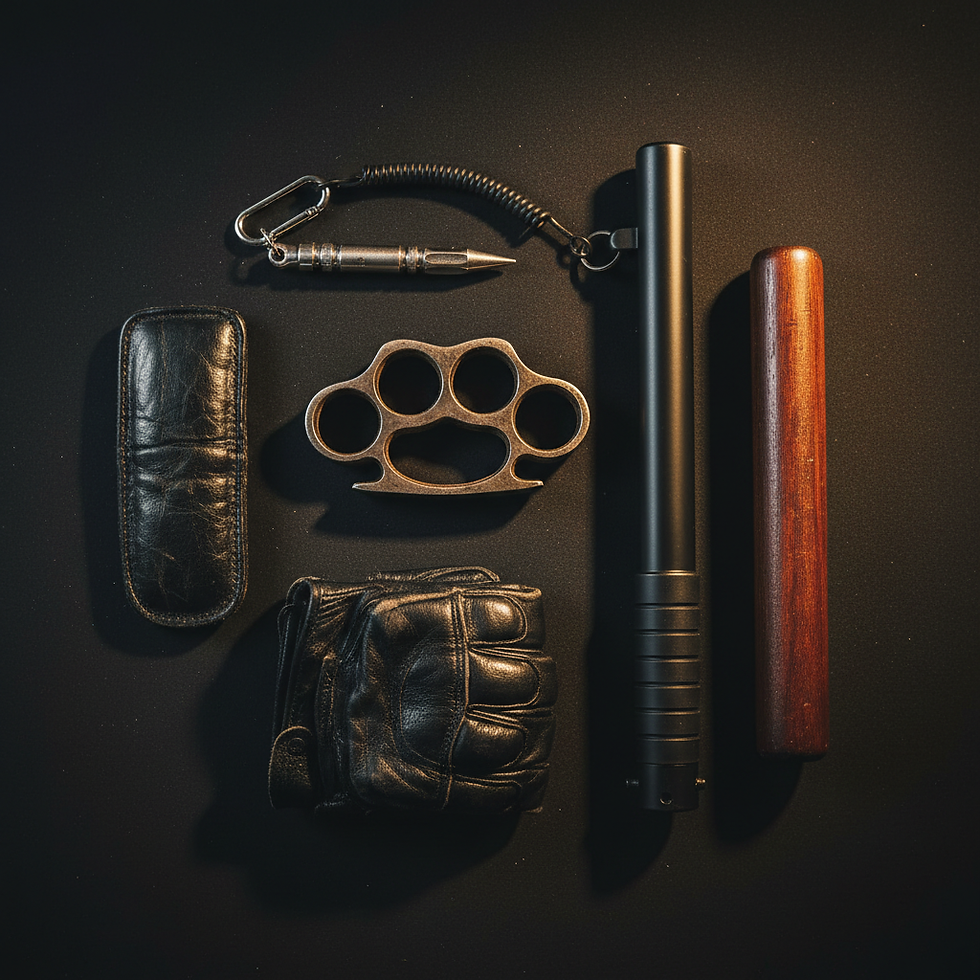
Most conversations about self-defense jump straight to firearms. But a large slice of everyday carry lives in a quieter space: tools that can stop a threat without the finality of a firearm. Impact weapons sit at the center of that conversation. They range from objects you can hide in a closed fist to full-sized batons that dominate a room the moment they appear. This guide walks through six categories, explains what each one does well, where each one falls short, and what the law has to say about all of it.
The Concealable Tier: What Fits in a Pocket or a Fist
Concealable impact weapons share a single trait: they disappear on your person until the moment you need them. That is their core advantage. Their core limitation is reach. You are already inside arm's length of a threat before any of them become useful.
Brass Knuckles and Single Knuckles
Brass knuckles slip over the fingers and transform a bare-hand punch into a strike backed by a solid metal frame. A single knuckle covers one or two fingers and is even more compact. Both amplify impact, protect your hand from fractures, and disappear into a jacket pocket.
The legal picture is sharply divided. As of 2026, about 21 states ban brass knuckles entirely, including California, New York, and Illinois. Texas legalized them in 2019. Florida and Alabama allow carry with a concealed weapon permit. Some states treat composite or polymer knuckles identically to metal ones under "dangerous weapon" statutes, so material choice offers no legal escape hatch. Check your state law before purchase, and check it again before crossing state lines.
Blackjacks and Saps
A blackjack is a compact leather cylinder with a lead weight at the striking end. A sap is flat, more like a wide leather paddle with a lead-filled head. Both work by transferring kinetic energy through a whipping motion into a relatively small contact area. Historically, law enforcement used them to subdue suspects without drawing a firearm.
Today, most agencies have retired them precisely because the injury risk is high. A strike to the head can cause permanent brain injury or death, which legally elevates these tools from "less lethal" to "deadly weapon" in a courtroom. Most U.S. states, including California, Nevada, Washington, and Virginia, prohibit possession outright. They are not a practical recommendation for civilian carry, both legally and ethically.
Kubotans
A kubotan is a small, hard cylinder, roughly five inches long, typically carried as a keychain fob. It is one of the most legally permissive tools in this category because most jurisdictions do not specifically define it as a weapon. It extends the knuckle line when striking and excels at pressure point applications on nerve clusters in the wrist, forearm, and hand.
The honest limitation: a kubotan requires real training to use effectively. Without practiced technique, it is just a stick in your hand. With training, it becomes a reliable force multiplier that attracts almost no attention.
Recommendation: The kubotan earns a strong mark for general civilian carry. It is affordable, widely legal, discreet, and pairs well with basic self-defense training.
Sap Gloves
Sap gloves look like leather work gloves or tactical gloves. The difference is inside: lead powder or steel shot packed into padding over the knuckles and the back of the hand. They add mass to every punch and protect your hand at the same time.
The visual stealth is real. Worn in cool weather, they read as ordinary gloves to anyone watching. The legal stealth is not. Many states classify them as prohibited "weighted gloves" or "metallic knuckle" variants. Using them offensively, even in a legitimate self-defense situation, can result in a felony charge in jurisdictions that ban them. Know the law in your state before you buy a pair.
The Mid-Tier: Deployable but Not Pocketable
Expanding Batons
An expanding baton, often called an ASP after the dominant brand, collapses to six or eight inches and deploys with a flick of the wrist to sixteen, twenty-one, or twenty-six inches. That transformation from compact to full-length in under a second is the tool's defining characteristic.
The reach advantage over any concealable weapon is significant. You can strike, block, and create distance without closing to grappling range. The deployment sound alone, a sharp metallic snap, carries a deterrent weight of its own.
Legality tracks closely with batons generally. California bans civilian carry under Penal Code 22210, though that law is being challenged in federal court. New York and Massachusetts prohibit them. Most other states allow ownership, though some require a permit for concealed carry. Carrying one openly is legal in more places than concealed carry.
Recommendation: For anyone with self-defense training and a clean legal path in their state, a quality expanding baton offers the best balance of portability and effective reach in this category. Invest in a friction-lock model from a reputable maker and train with it.
The Larger End: Presence and Power
Fixed Batons, Tire Knockers, and Bats
A fixed-length police-style baton, a heavy rubber tire thumper, or a wooden bat all share the same profile: they are long, visible, and impossible to mistake for anything other than what they are. At twenty-four to thirty-six inches, they generate far more force than any concealable tool and can be used to block and redirect attacks as well as strike.
The tradeoff is equally obvious. You cannot carry a baseball bat in a waistband. These tools live in a vehicle, at a worksite, or at home. A bat or tire knocker stored legally in a car is not inherently a weapon in most states, but the moment a prosecutor can demonstrate it was carried specifically as a weapon, that calculus changes. Context, intent, and circumstances determine legal exposure more than the object itself.
How Laws Shift Depending on Where You Are
State law is the starting point, but it is rarely the whole picture. Here are the layers that matter:
State statute defines what is legal to own, legal to carry, and legal to use in self-defense.
Local ordinances can be more restrictive than state law. A city may ban items the state permits.
Sensitive locations create universal prohibitions. Schools, courthouses, government buildings, and airports are off-limits for virtually every impact weapon regardless of state law.
Intent and context matter in prosecution. A tool carried for work or utility is treated differently than one carried specifically as a weapon, even when the object is identical.
Use of force standards govern what you can legally deploy in a self-defense claim. A weapon that is legal to carry can still result in criminal charges if the force used is deemed disproportionate to the threat.
The core rule: research the laws of every jurisdiction you travel through, not just where you live. A tool legal in your home state may carry felony penalties one state over.
The Grey Man Filter

The grey man principle is simple: the person who draws no attention is the person who retains options. Applied to impact weapons, this filters the list in a specific way.
A collapsible baton clipped to a belt loop signals preparation. Brass knuckles in a front pocket print through thin fabric. A sap glove worn in July raises questions. But a kubotan on a keychain is just a keychain. A pair of plain leather gloves in October is just cold weather gear. A tire thumper on the floor of a work truck is just a work truck.
The grey man does not avoid capable tools. The grey man chooses tools that carry no story until a story is needed. Concealability and social invisibility are separate things. A tool can be small and still look tactical. A tool can be large and still look ordinary. The goal is the second category in both cases.
Train with what you carry. Know the law where you are. Choose tools that solve problems without announcing that you solve problems.
Final Thought
The best impact weapon for most people is the one they will actually carry, that they have trained with enough to use under stress, and that will not cost them their freedom because they did not read their state's statutes. That combination rules out a lot of dramatic-looking options and points toward a short list of practical ones.
Start legal. Stay trained. Stay quiet about it.
Your gear does not have to look dangerous to be dangerous.


Comments