Rethinking the Greyman Concept: Overused Terminology and Better Alternatives
- mstoffo
- May 28
- 3 min read
The Problem With "Grey Man"
The term gets thrown around so often in preparedness circles that it has nearly lost meaning. What started as a useful mental model for staying unnoticed has become a product category, a persona, and for many, a shopping list. That's a problem.
Why the Term Has Worn Out Its Welcome
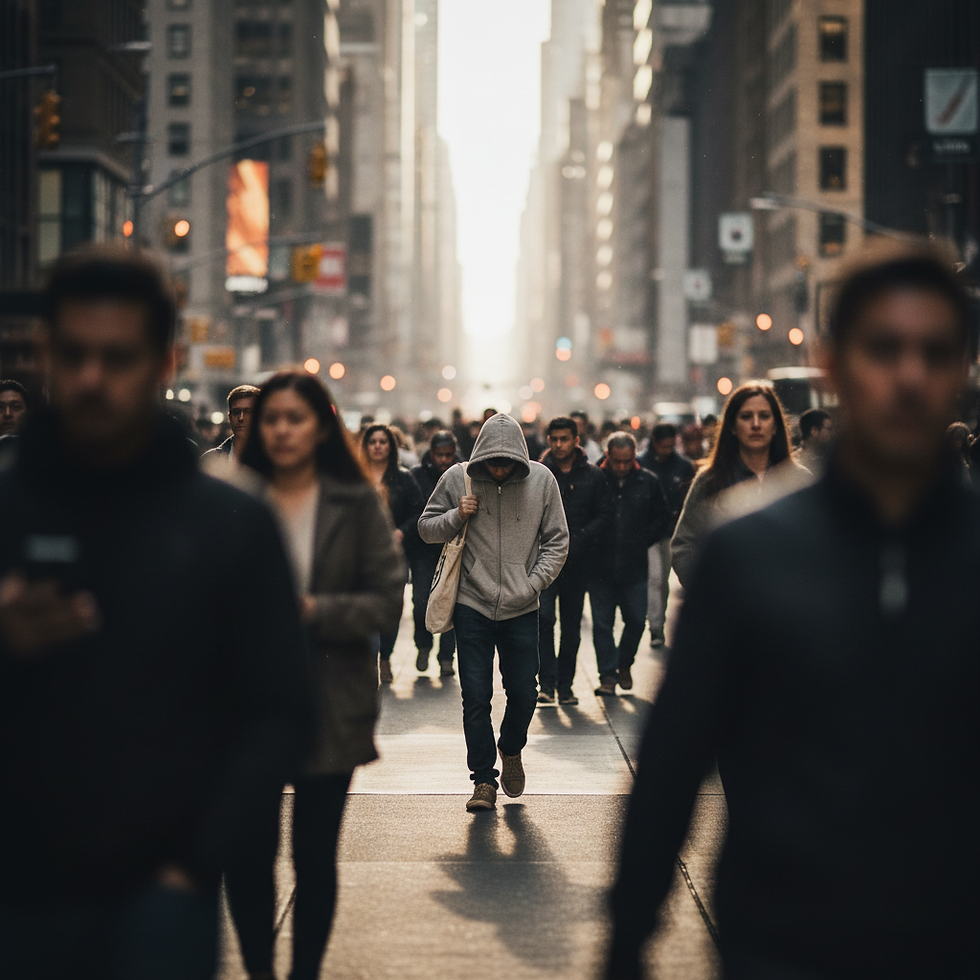
The original idea was sound: in a crisis, don't look like a target. Don't signal that you're armed, prepared, or carrying anything worth taking. Move without friction. Be forgotten the moment you pass.
But somewhere along the way, the idea got packaged and sold back to us. Now "grey man" is a brand. Gear companies sell "low-profile" bags in matching charcoal colorways. Specific pants, specific boots, specific chest rigs. The irony is real: enough people bought into this uniform that trained observers, criminals, and even curious strangers now recognize it instantly. The anti-profile became a profile.
Three more reasons the term has become noise:
It assumes everyone can blend in equally. If you're 6'5", or visibly different from the local demographic, no shirt color fixes that.
It encourages passivity. Looking downward, avoiding eye contact, acting unremarkable — these habits directly conflict with real situational awareness, which requires active scanning and projecting confidence.
It promotes isolation. The more you focus on being invisible, the harder it becomes to build the community relationships that matter far more in a real long-term crisis.
Where the Idea Still Holds Up
Strip away the branding, and the core principle is genuinely useful. Criminals use target selection. They look for signals: visible gear, nervous behavior, expensive items, signs of confrontation. Disrupting those signals is a real, proven layer of personal safety.
The concept also draws on solid behavioral science. The brain's reticular activating system filters out stimuli it considers normal. Stay below that threshold and most people literally won't register you. That's not mystical — it's how human attention works. Match the baseline of your environment and you become noise, not signal.
What It Gets Right
Criminals skip targets that look unremarkable and resource-poor
Concealed capability preserves the element of surprise
Moving without drawing attention is faster through crowds and checkpoints
Reducing social friction conserves mental energy during high-stress situations
What It Gets Wrong
Tactical low-profile gear has become its own recognizable uniform
Physical reality limits who can actually "blend in" anywhere
Deep concealment slows access to gear when seconds matter
Over-calculating neutrality can look stranger than just acting naturally
The Gear Problem: When "Low Profile" Becomes a Uniform

Vertx pants. A grey sling bag. Non-branded boots. A plain tee over a concealed holster. If you've been in the preparedness space for more than a year, you can spot this "look" across a parking lot. So can anyone else who has been around it. The anti-profile became its own subculture uniform, and that defeats the entire purpose.
The fix isn't better gear. It's actually wearing what the people around you wear. In a downtown office area, that's business casual. In a suburban grocery store, it's jeans and a hoodie. The environment sets the standard, not a product line.
Better Ways to Say It
If the concept is still useful (and it is, when applied correctly), here are cleaner, more precise terms that say the same thing without the baggage:
Term | What It Communicates |
|---|---|
Baseline matching | Identifying the normal look and behavior of a specific environment and mirroring it. Precise, behavioral, and environment-dependent. |
Low profile | Standard military and security term. Understood across disciplines. Clean and jargon-free. |
Target de-selection | Focuses on the actual goal — not being chosen as a target — rather than a vague idea of invisibility. |
Adaptive camouflage | Emphasizes active adaptation to each specific context, not a fixed aesthetic or wardrobe. |
Non-attribution | Intelligence community term. Gear or behavior that can't be traced to a specific group, capability, or affiliation. |
Unremarkable presence | Plain English. No subculture baggage. Describes exactly what the goal is. |
The Takeaway
The idea behind "grey man" is real and worth keeping. The term itself has been stretched too far and sold too hard. Use it if you need shorthand with someone who already knows the world. But when you're explaining the concept to someone new, or writing about it seriously, reach for something more specific.
Baseline matching. Low profile. Target de-selection. These terms say exactly what you mean without dragging in a decade of overmarketed gear culture with them.
You dont have to look grey to be grey !


Comments