Unlocking the Secrets of Raking: A Comprehensive Guide to Lock Picking Techniques and Security Levels
- mstoffo
- May 8
- 7 min read
Disclaimer: This guide is intended for educational purposes only. Lock picking is a legitimate skill used by locksmiths, security professionals, and hobbyists in the sport of locksport. Always pick locks you own or have explicit written permission to practice on. Unauthorized entry is illegal.
What Is Lock Picking?
A lock works by blocking a plug (the rotating cylinder you turn with a key) from spinning. Inside the lock, a series of spring-loaded pin stacks sit across the gap between the plug and the outer housing. When the correct key is inserted, each pin is lifted to exactly the right height so that the gap between the upper and lower pin aligns perfectly with the shear line. At that moment, the plug is free to rotate and the lock opens.
Lock picking is the art of replicating that condition without the original key. There are several approaches: single pin picking (SPP), impressioning, decoding, and raking. Raking is by far the fastest and most beginner-friendly. It trades surgical precision for speed, relying on rapid random motion rather than careful manipulation of individual pins.

Raking: The Fast-and-Loose Approach
Raking is a kinetic attack. Instead of lifting each pin to the shear line individually, you use a shaped tool called a rake to rapidly bounce multiple pins at once while applying light rotational tension with a tension wrench. The idea is that through random motion, all pins will momentarily align at the shear line at the same time, allowing the plug to rotate.
Think of it like shaking a box of marbles through a sieve: you're not placing each marble by hand, you're just shaking until they fall through on their own. It's unpredictable, but it works surprisingly often on basic locks.
The critical variable is tension. Too much tension binds the pins so they can't move. Too little lets set pins drop back down. The sweet spot is often described as "the pressure you'd use to press a laptop key." This light, consistent tension is what makes raking work.
The Core Rake Tools
Rake picks come in several profiles, each suited to different techniques and keyway sizes. Here are the three you'll encounter most:

Snake Rake (C-Rake)
A smooth, wavy, serpentine profile with rounded peaks. It fits easily into tight keyways and is moved in a rapid scrubbing motion (in and out) while varying the angle slightly. The snake is the most versatile rake for small padlocks and standard door locks.
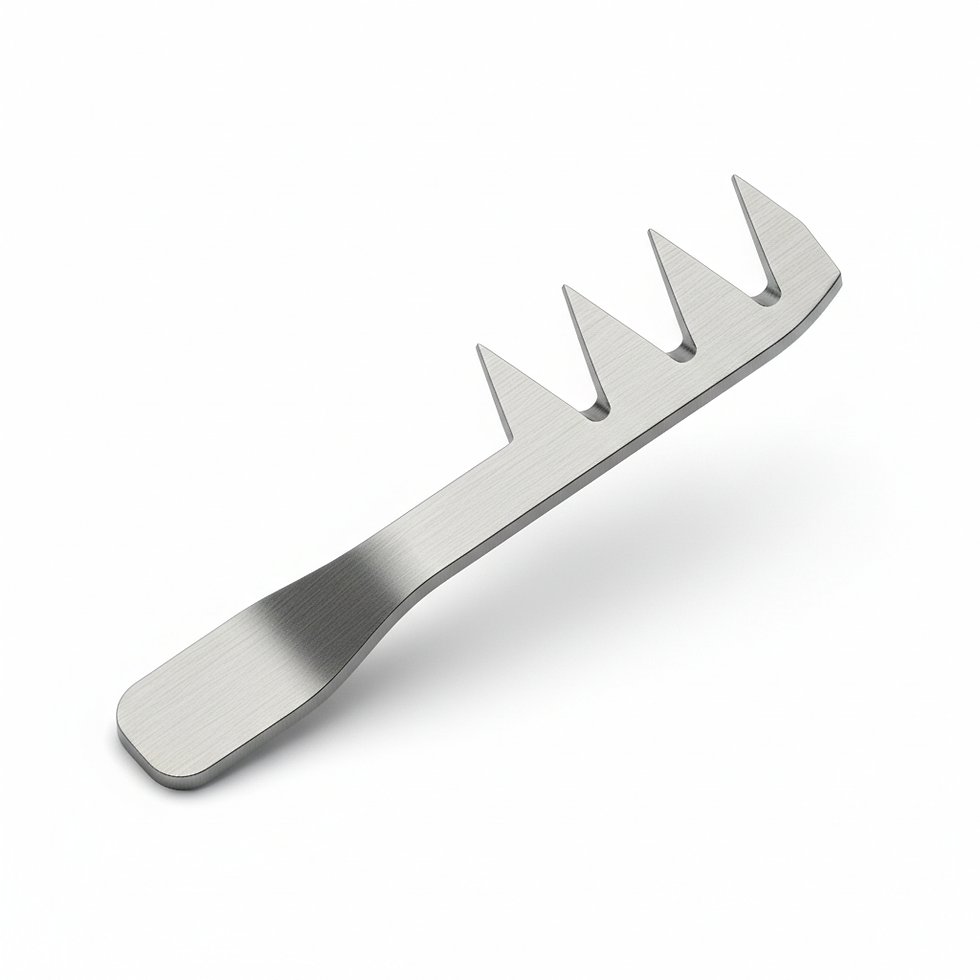
Bogota Rake
Features three sharp, prominent peaks of varying heights. The Bogota is aggressive and fast, making it one of the most effective rakes on standard five-pin locks. Its pronounced peaks hit multiple pins at different heights on every stroke.

City Rake (L-Rake)
A jagged, saw-tooth edge that mimics a city skyline. Rather than scrubbing, the city rake is rocked up and down inside the lock like a rocking chair. This "rocking" motion mimics the bitting pattern of a real key and is especially effective on locks with evenly stepped pin heights.
How Raking Is Performed: Step by Step
The technique breaks down into four clear steps:
Insert the tension wrench. Place it at the bottom of the keyway and apply very light rotational pressure in the direction the key would turn. Hold it steady throughout.
Insert the rake. Slide the rake above the tension wrench, pushing it toward the back of the lock until it clears all the pin stacks.
Scrub or rock. Pull the rake back and forth rapidly while varying the height and angle slightly. For the city rake, rock it up and down instead. Maintain your light tension the whole time.
Reset if needed. If nothing happens after 10 to 20 seconds, release tension completely to let all pins drop, then start again. Some locks open on the first pass; others need several attempts.
A common variation called zipping skips the scrubbing and instead yanks the rake out of the keyway in one fast jerk. The kinetic energy throws all the pins upward at once, which occasionally aligns them all at the shear line in that single instant. It sounds crude, but it works on low-quality locks with loose tolerances.

What Raking Can and Cannot Do
Where Raking Works
Standard pin tumbler locks with basic driver pins (the most common type found in residential deadbolts and padlocks)
Locks with uniform or stair-step bitting (pin heights that don't vary dramatically between adjacent pins)
Locks with wide, unobstructed keyways that let the rake move freely
Wafer locks found in filing cabinets and older vehicles
Where Raking Fails
Locks with security pins (spools, serrated, or mushroom), which catch on the shear line and create false feedback
Locks with radical bitting where one pin is very short next to a very tall one, causing the rake to overset low pins while trying to reach tall ones
Locks with paracentric keyways, whose tight warded profiles physically prevent rake movement
High-security locks with sidebars (Medeco, ASSA Abloy) that require pins to be rotated to specific angles, not just lifted
Non-pin-tumbler mechanisms such as disc detainer locks, lever locks, and tubular locks
Electronic and smart locks with no physical keyway
Understanding Lock Security Levels: Pins, Keyways, and Beyond
Not all locks are equal. Security is built in layers, and understanding each layer explains why some locks resist raking easily while others fall in seconds.
Pin Types: From Basic to Advanced
The biggest upgrade any lock manufacturer can make is replacing standard driver pins with security pins. Here's how each type changes the picking experience:

Standard driver pins are simple cylinders. They're fast to pick because they give clear feedback and don't resist at the shear line.
Spool pins have a narrow "waist" like a barbell. When the waist reaches the shear line, the plug rotates slightly and stops, creating a false set. A picker must recognize this, ease tension slightly, and allow the wider lip to clear. Raking cannot reliably produce this sensitive back-and-forth.
Serrated pins feature multiple notches along their length, each of which mimics the feel of a set pin. A picker must navigate through several false clicks before reaching the real shear line.
Mushroom pins taper to a rounded top. They behave similarly to spools but are harder to detect because their slopes produce subtler counter-rotation feedback.
Christmas tree pins (found in premium locks like ASSA) feature stacked serrations along the entire body. They require extremely light tension and near-perfect technique to pick.
Keyways: Restricting Tool Access
The shape of the keyway controls how easily a pick or rake can enter and move inside the lock. A wide, open keyway like the Kwikset KW1 lets any rake swing freely. A paracentric keyway adds warding (ridges and protrusions) that crosses the centerline of the keyhole, physically blocking the movement of standard picks and forcing the use of much thinner, more specialized tools.
High-security patented keyways take this further. Schlage's Primus keyway, for example, includes a secondary set of side pins that must be engaged simultaneously with the main pin stack. Medeco's keyway requires keys to rotate pins to precise angles, not just lift them. No rake can accomplish this.
Keyway security can also be improved with restricted key systems, where the key blank is patented and can only be duplicated at authorized dealers. This doesn't stop picking but prevents unauthorized key copying.
Lock Security Tiers at a Glance
Here's a practical breakdown of how locks stack up against raking and picking in general:
Tier | Examples | Key Features | Rake Resistance |
|---|---|---|---|
Entry Level | Kwikset KW1, cheap padlocks | Standard pins, wide open keyway, loose tolerances | Very low. Opens in seconds. |
Mid Range | Schlage B-series, Mul-T-Lock MT5 | Spool or serrated pins, improved keyway warding | Moderate. Raking usually fails; SPP is slow. |
High Security | Medeco, ASSA Abloy Protec2, Abloy Protec | Sidebar mechanisms, rotating pins or disc detainers, patented keyways | Extremely high. Raking is completely ineffective. |
Smart / Electronic | August, Yale Assure, Schlage Encode | No physical keyway (or hardened backup cylinder) | Not applicable. Different attack surfaces entirely. |
Improving Your Lock's Security
If raking is this accessible, what can you do about it? The answer isn't to panic; it's to upgrade intelligently.
Upgrade pin stacks. Some locksmiths can retrofit spool or serrated driver pins into existing locks, dramatically raising the difficulty for any picker without replacing the whole lock.
Choose a narrower keyway. Ask a locksmith about rekeying to a more restricted keyway profile on the same lock brand.
Invest in a high-security deadbolt. For exterior doors, locks rated ANSI/BHMA Grade 1 with security pins are a major step up from standard builder-grade hardware.
Add a secondary mechanism. A door chain, floor bolt, or smart lock alarm adds friction even if a physical lock is defeated.
Consider a restricted key system. Brands like Medeco and Mul-T-Lock offer key control programs that prevent unauthorized duplication.
Going Further: Reference Materials
These resources are well-regarded in the locksport and security communities for accurate, detailed information:
LockWiki — a comprehensive wiki covering lock mechanisms, pick types, security pins, and bypass techniques in technical depth.
SouthOrd: Understanding the Rake Technique — a practical, beginner-friendly breakdown of raking mechanics and tool selection.
LockPickWorld: Absolute Beginner's Guide — covers SPP, raking, tools, and the shear line concept for newcomers.
r/lockpicking on Reddit — an active community with a structured belt ranking system, beginner guides, and feedback on specific locks.
LockLab by BosnianBill — deep technical content on picking advanced locks, security pin feedback, and high-security mechanisms.
KSEC: Security Pin Guide — a visual breakdown of every major security pin type and how each one creates feedback during picking.
Raking is one small corner of a much broader field. The more you understand how locks are designed to resist manipulation, the better equipped you are to evaluate and improve your own security. Whether you're a curious hobbyist, a locksmith in training, or a homeowner shopping for a new deadbolt, knowing what's inside the cylinder changes how you look at every door you walk through.
You dont have to look dangerous to be dangerous


Comments