Essential Tips for Improving Your Shooting Skills Without Breaking the Bank
- mstoffo
- May 8
- 5 min read
You don't need a lot of money or a range membership to become a better shooter. You need two things: desire and time. Those two things create the conditions for practice, and practice is what separates a good shooter from a great one.
This post is written with the everyday person in mind. No military background required. No special gear. No complicated jargon. Just practical, proven ways to build real shooting skills on a real schedule and a real budget.
Train a Little, a Lot
One of the biggest myths in shooting is that you need long, intense range sessions to improve. You don't. Short sessions practiced more often are far more effective, especially for beginners.
Here's why that matters: experts agree that building a new skill requires somewhere between 300 and 500 repetitions to start forming the neural pathways in your brain. To reach true muscle memory, the kind where your body just does the right thing automatically, you need around 30,000 repetitions. That sounds like a lot. But you get there the same way every time: one rep at a time.
A focused 10-minute session done five days a week will build more skill than one two-hour session on a Saturday. Consistency wins.
You Don't Have to Shoot to Improve
This surprises most beginners. The majority of what makes a good shooter has nothing to do with pulling the trigger on a loaded gun. Live fire at the range is important, but it's expensive. Ammo costs money. Range fees cost money. Fuel costs money. And if your fundamentals are weak, you'll just be reinforcing bad habits with expensive rounds.
The smarter approach is to build your fundamentals at home first, then use the range to confirm and test them. Here are the core skills you can train without spending a dime on ammo.
Grip Training

A strong, consistent grip is the foundation of accurate shooting. If your grip breaks down under recoil or fatigue, your shots will wander. The good news is that you can train your grip anywhere.
Weight training at the gym helps, but the most targeted tool is the classic hand gripper. Those old-school spring-loaded "nutcracker" style grippers are inexpensive and effective. Newer versions even include individual finger pads and a clip-on sight to help you practice isolating your trigger finger while strengthening the rest of your hand.
The goal is a firm grip from your support hand and middle, ring, and pinky fingers of your shooting hand, while your trigger finger stays completely relaxed until it's time to fire. That separation takes practice.
The grey man angle here: a hand gripper looks like gym equipment. Use it while watching TV. Nobody around you needs to know what you're training for.

Dry Fire Training
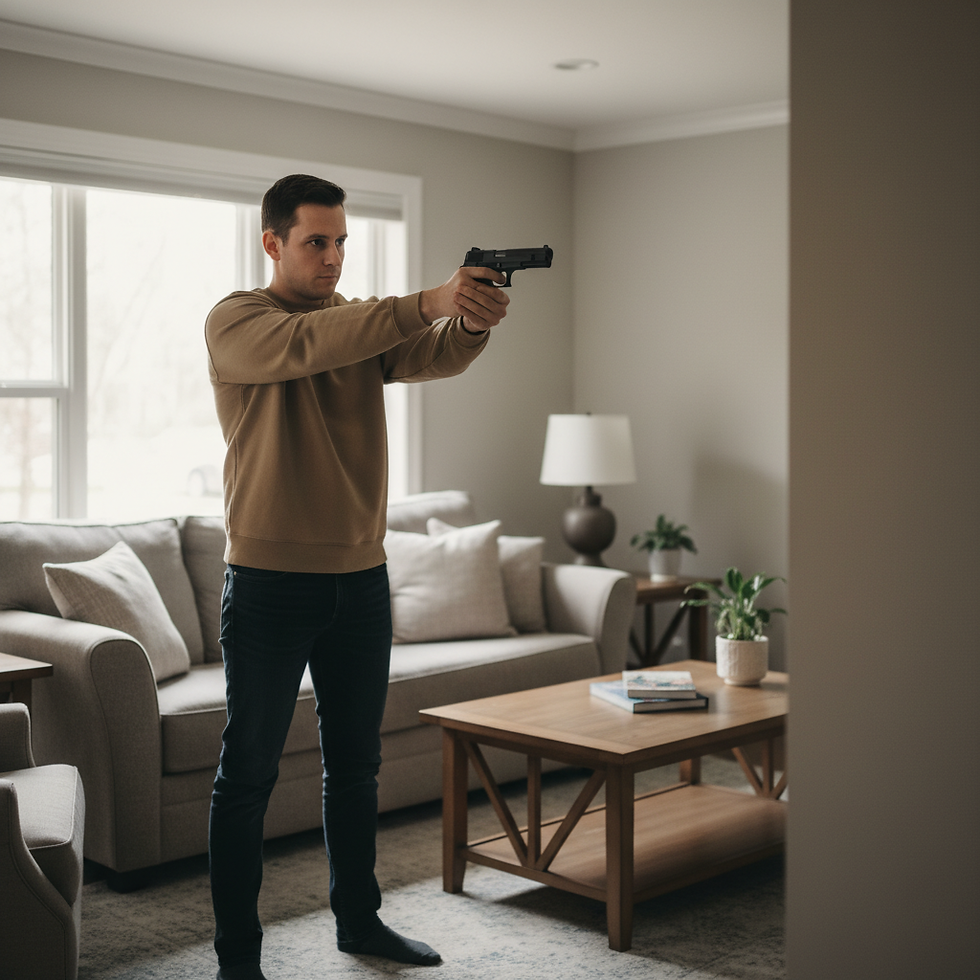
Dry fire simply means practicing with an unloaded firearm. It's one of the most powerful training tools available, and it costs nothing once you own the gun.
Safety first, always. Before any dry fire session, follow the four cardinal rules of firearm safety:
Treat every firearm as if it is loaded
Never point it at anything you are not willing to destroy
Keep your finger off the trigger until your sights are on target
Know your target and what is beyond it
Before you dry fire, verify the firearm is unloaded. Then verify again. Remove all ammunition from the room if possible. Always aim in a safe direction, such as toward an exterior wall or a purpose-built dry fire target.
Once you're set up safely, dry fire is surprisingly effective. Without the noise and recoil of a real shot, you can clearly see whether your sights move when you press the trigger. That wobble tells you everything about where your technique needs work. It removes the flinch reflex that many beginners develop, because there's nothing to flinch from.
Skills you can build through dry fire:
Trigger press: smooth, consistent, no jerking
Sight alignment and sight picture
Draw from holster: slow and smooth beats fast and sloppy
Reload drills: magazine changes done from memory
Malfunction clearances: tap, rack, reassess
You can do this while watching TV. Set up a safe target on the wall, run through your drills during commercial breaks. Fifteen minutes a day adds up fast. A week of daily dry fire gives you more quality trigger time than most people get in a month of occasional range visits.
There are also dry fire training tools that use laser inserts or app-based targets to give you real-time feedback. These are worth exploring once you've got the basics down, but they're not required to start.
The Draw from Holster
Drawing a firearm from concealment is a perishable skill. It requires coordination between your hand clearing your cover garment, establishing your grip on the gun, and bringing it on target, all in a smooth, controlled motion.
Beginners should start this practice slowly. Speed comes naturally once the movement is correct. A fast, sloppy draw is dangerous and inaccurate. A slow, perfect draw can always be made faster with repetition.
Practice the draw in stages:
Clear the cover garment
Establish your grip while the gun is still holstered
Draw straight up and rotate toward the target
Extend to a full firing position
Grey man note: practice your draw in everyday clothes, not range gear. Your normal carry clothing is what you'll be wearing when it counts. Practice in that. A button-down shirt, a light jacket, or a t-shirt all behave differently during the draw. Know how yours performs.
Reloads and Malfunction Drills
An empty gun or a jammed gun is a problem. Clearing that problem smoothly and quickly is a skill, and like any other skill, it responds to repetition.
Practice magazine changes until they feel automatic. Practice clearing common malfunctions like a failure to fire (tap the magazine, rack the slide, reassess) and a stovepipe (tilt, swipe, rack) until your hands do it without your brain having to think through each step.
These drills can all be done with dummy rounds or an empty magazine at home. No live ammo needed.
Maximize Your Range Time
When you do get to the range, go with a plan. Shooters who show up without a plan tend to blast through ammo quickly and come home having confirmed their existing habits rather than built new ones.
A simple range session structure for beginners:
Start slow and close. Five to seven yards. Focus on mechanics, not speed
Work on trigger press first. A clean shot at close range confirms your grip and trigger control are solid
Then practice your draw-to-first-shot sequence
Run a few reload drills under light pressure
Finish with a simple assessment: shoot a group at ten yards and see where you are
Keep sessions under an hour for most beginners. Fatigue causes bad habits. You want to leave the range while your technique is still sharp, not after it has broken down.
The Grey Man Approach to Training
You don't need to look like you're preparing for anything. The goal is to blend in, stay low-profile, and build real skills quietly. That means:
Train in the clothes you actually wear every day
Use tools that look ordinary (hand grippers, standard holsters, plain bags)
Don't announce your training to people who don't need to know
Focus on fundamentals over flashy gear
Capability matters more than appearance. A person who has run 10,000 dry fire repetitions in jeans and a polo shirt is far more prepared than someone with expensive kit and no real training behind them.
The Bottom Line
Becoming a competent shooter does not require a big budget, a military background, or hours at the range every week. It requires consistency, safe habits, and a willingness to put in the quiet work when nobody is watching.
Start with grip training during your downtime. Add dry fire to your daily routine. Practice your draw in the clothes you wear every day. When you do hit the range, go with a plan and make every round count.
The repetitions add up. The skill builds. And when it matters, your body will know what to do.
Your gear does not have to look dangerous to be dangerous.


Comments