The Grey Man's Guide to Choosing Knives: Fixed vs Folding, Top Steel Types, and Key Features
- mstoffo
- May 8
- 8 min read
The grey man philosophy is simple: be invisible. Your gear should never announce itself, never draw a glance, and never telegraph your intentions. A knife is no different. Whether you carry a folder in your pocket or a fixed blade under your shirt, the goal is the same — a capable tool that no one notices until it matters.
Fixed vs. Folding: Knowing What You're Carrying and Why
Both fixed blades and folding knives have a place in the grey man's kit. The right choice depends on your environment, your mission, and how well you understand the trade-offs of each.
Folding Knives
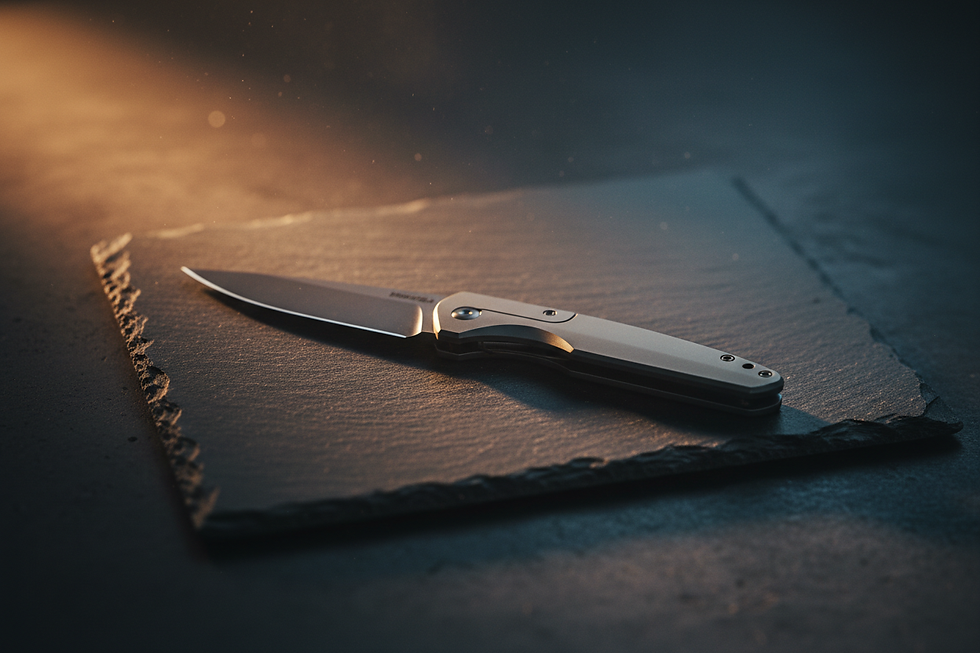
A folder collapses to roughly half its deployed length, slips into a standard pocket, and — with the right deep-carry clip — leaves no visible signature above the pocket line. That makes it the default choice for most urban and office environments.
Pros of Folding Knives
Superior concealability — folds flat, disappears in a standard pocket
Socially acceptable in most environments, including offices and urban settings
Deep-carry clips allow a near-zero visible profile
Generally less scrutinized legally across a wider range of jurisdictions
Lighter and easier to pocket carry for extended periods
Cons of Folding Knives
Slower deployment — requires a mechanical action (flipper, thumb stud, or nail nick)
Pivot and lock mechanism are failure points under hard use
Pocket lint and debris accumulate in the pivot, requiring more maintenance
Cannot handle heavy prying or full lateral torque without risk of blade play developing
Assisted or automatic openers produce audible deployment sounds — a liability in discreet environments
Fixed Blade Knives
A fixed blade has no pivot, no lock, and no moving parts. The blade and handle are one continuous piece of steel. That structural simplicity is what makes it the most reliable tool you can carry — but it demands a more deliberate carry strategy to maintain a low profile.

Pros of Fixed Blades
Instant deployment — no mechanical step between draw and use
Full-tang construction handles prying, chopping, and heavy lateral stress
Zero moving parts means zero mechanical failure points
Easier to clean and maintain — no tight pivot gaps to flush out
More blade length-to-carry-size efficiency for survival or field use
Cons of Fixed Blades
Requires a sheath and deliberate carry method (scout, IWB, ankle, or neck carry) to stay hidden
Prone to printing through clothing if the sheath or blade profile is too large
More legally restricted in urban jurisdictions — perceived as more threatening than a folder
Harder to justify socially if observed drawing or handling in public
Many experienced grey man practitioners run both — a slim folder for everyday utility and a small fixed blade carried inside the waistband or in a scout position for situations that demand real capability.
The Steel Beneath the Surface
The steel a knife is made from determines how long it holds an edge, how tough it is under abuse, and whether it will rust on you. The marketing on the box is irrelevant. The steel grade is what matters. Three steels consistently earn their place in any serious carry kit.
S35VN — The All-Around Standard
S35VN is the evolution of the once-dominant S30V. The addition of niobium refines the grain structure, producing a steel that is approximately 15 to 20 percent tougher than its predecessor. It holds an exceptional edge, resists corrosion well, and is harder to chip during impact-heavy tasks like light chopping or prying. It is the closest thing to a universal answer for both folders and fixed blades. If you carry one steel and want to stop thinking about it, this is the one.
CPM-154 — The Field-Maintainable Edge
CPM-154 is a powder metallurgy version of the classic 154CM steel. It takes a finer, sharper edge than the S-series steels and is significantly easier to sharpen in the field with basic tools. It is exceptionally tough and resists corrosion well. For those who prefer a working edge they can maintain on the go rather than a factory edge they babysit, CPM-154 is a natural fit. It is a favourite among custom makers and survivalists who know they will need to touch up their blade without a bench setup.
D2 — The Hard-Use Workhorse
D2 is a high-carbon, high-chromium tool steel. It runs at 58 to 62 HRC hardness and holds an edge through abrasive work — cardboard, rope, webbing, and hard materials that eat through softer steels quickly. It is not fully stainless (roughly 12 percent chromium), so it will develop surface oxidation if neglected. A light coat of oil after use is non-negotiable. The trade-off is that D2 is frequently found in mid-range knives that punch well above their price point, making it one of the best value propositions in working steel.
What to Avoid in a Cheap Knife
Budget knives are not inherently bad. Some perform well above their price. But certain construction shortcuts are clear signals that a knife will fail you when it matters most.

Unspecified "stainless steel" or "surgical steel"
These labels mean nothing. If the manufacturer will not print a specific steel grade, assume it is a soft, low-hardness alloy that will lose its edge after one session of real work and resist sharpening.
Rat-tail or partial tangs in fixed blades
A rat-tail tang is a thin rod of steel welded or pinned to the base of the blade and running through the handle. Under lateral stress or prying loads, it will snap. A full tang — steel visible along the full perimeter of the handle — is non-negotiable for any fixed blade you depend on.
Blade play in folders
A folder with lateral blade play out of the box will only get worse. The pivot is already sloppy, and the liner or frame lock is not seating the blade properly. This is a safety issue as much as a quality one.
Smooth or slippery handle materials
Polished metal, shiny plastic, or hollow-feeling handles become dangerous when wet or bloody. A knife you cannot grip under stress is worse than no knife at all.
Gimmick features masking poor fundamentals
Serrated spines, aggressive skull motifs, tactical coatings, or "military grade" marketing on a sub-$20 blade are usually covering for mediocre steel and cheap assembly. The grey man avoids these aesthetically and practically.
Poor fit and finish
Run your thumb along the spine and handle edges. Sharp burrs or hot spots mean the knife was not finished. Gaps between handle scales and the tang mean moisture intrusion and structural weakness. Uneven grinds mean inconsistent cutting geometry. These are not cosmetic issues — they signal rushed manufacturing throughout.
What a Well-Built Knife Actually Looks Like
Knowing what to avoid gets you halfway there. Knowing what to look for closes the gap. These are the features that separate a capable tool from an expensive paperweight.
Fixed Blades
Full through-tang construction
The steel runs the full length and width of the handle. Handle scales — G10, Micarta, or stabilized wood — are pinned or bolted to the tang, not glued to a partial rod.
Distal taper
The blade gets progressively thinner from ricasso to tip. This distributes weight toward the handle, improves balance, and makes the knife a slicer rather than a wedge.
Consistent primary grind
The bevel should be even and symmetrical from tip to heel. An uneven grind cuts on one side and pushes on the other.
Secure, retention-positive sheath
A quality sheath holds the knife with positive retention — no rattle, no accidental release — while still allowing a clean, one-handed draw. Kydex and quality leather both achieve this at different price points.
High-friction handle material
G10 and Micarta are the benchmarks. Both maintain grip when wet, resist moisture absorption, and do not crack or warp under temperature extremes.
Folding Knives
Centred blade with zero lateral play
The blade must sit perfectly centred between the liners or scales in the open and closed position. It must not flex left or right under thumb pressure when deployed and locked.
Quality pivot system
Ceramic ball bearings or phosphor bronze washers at the pivot produce smooth, consistent deployment without slop. Cheap brass washers or plastic bushings will degrade quickly.
Reliable lock mechanism
Frame locks, liner locks, and axis-style locks each have their proponents. What matters is that the lock seats fully, engages consistently, and shows no movement under lateral or spine pressure when tested with hand force — not machine testing claims on a box.
Deep-carry clip
For the grey man, the clip must sit flush at or below the pocket line. A full-height clip advertising the knife's presence is a design failure for this application. Low-profile, reversible, dark-finished clips are the standard.
Silent manual deployment
Assisted and automatic openers are fast, but the mechanical "clack" of deployment is audible. In quiet, discretion-required environments, a smooth manual thumb-stud or nail-nick opener preserves the low signal profile.
Top 3 Fixed Blades Worth Considering
These knives are highlighted because they meet the grey man's criteria across build quality, carry profile, and steel selection. They represent what is possible at or near their respective price points. There are many reputable makers producing excellent blades — personal preference, hand size, carry method, and intended use are all valid factors. What matters is that the knife you carry meets the minimum standards above.
Benchmade Dacian
A purpose-built low-profile fixed blade with a 3.5-inch spear point blade in CPM-MagnaCut steel and denim Micarta handles. It ships with a leather scout-carry sheath designed for horizontal belt positioning — one of the most effective grey man carry methods for a fixed blade. The profile is slim, the finish is subdued, and the steel choice signals that Benchmade built this for someone who intends to use it.
Bradford Guardian 3.2
At 7.125 inches overall, the Guardian 3.2 is compact enough for horizontal belt carry or pocket carry in a sheath. Available in MagnaCut and M390, both of which exceed the steel criteria above. The finger guard adds a safety margin during hard use, and the fit and finish are among the best at this size class. It is a consistent reference point in the EDC fixed blade category for good reason.
CRKT Minimalist Series
Designed by Alan Folts, the Minimalist series covers multiple blade profiles — Nessmuk, drop point, and wharncliffe — in an extremely compact, lightweight package. These carry as neck knives or tuck behind a belt with a static cord, making them among the easiest fixed blades to disappear into a grey man loadout. For those new to fixed blade EDC, the Minimalist is an accessible entry point at a price that does not punish the learning curve of carry method.
Top 3 Folding Knives Worth Considering
The same principle applies here. These folders are highlighted for their performance, low visual signature, and build quality. Preferences in blade shape, handle ergonomics, and lock style are personal — use these as a starting point, not a final word.
Benchmade Bugout (535 Series)
The Bugout weighs under two ounces and carries at 0.42 inches thick. The deep-carry clip puts it well below the pocket line, and the slim handle profile leaves no visible print through light fabric. The AXIS lock is one of the most robust and field-repairable mechanisms available in a production folder. It has been a benchmark for grey man folding carry for years because it solves the core problem well — capable blade, minimal presence.
Spyderco Para 3 Lightweight
The Para 3 LW uses a wire deep-carry clip that is more discreet than most stamped metal clips on the market. The compression lock is one of the strongest lock designs in production folders, and the FRN handle keeps weight at approximately 2.4 ounces. The Salt series variant in MagnaCut offers near-complete corrosion resistance for humid, maritime, or wet-environment carry. The Spyderco round hole is immediately recognisable to knife people but reads as a plain pocket tool to everyone else — exactly the grey man standard.
Hogue Deka
The Deka runs MagnaCut steel in a package that competes directly with the Bugout at a similar or lower price point. The ABLE lock is smooth and positive, the handle geometry provides a full grip without bulk, and the overall aesthetic is clean and non-tactical. It consistently earns attention as a value-to-performance standout in the EDC folder category. For those who want the grey man spec without the grey man price premium, the Deka is a serious contender.

The Minimum Criteria That Always Applies
Regardless of which knife you choose — fixed or folding, budget or premium — it must clear these bars before it earns a place in your carry:
Specified steel grade at 58 HRC or higher
Full tang (fixed) or zero lateral blade play (folder)
High-friction handle material — G10, Micarta, or equivalent
Carry system that maintains a zero visual profile
No gimmick aesthetics — nothing that reads "weapon" before it reads "tool"
Meet those criteria and the brand name, the price point, and the blade shape become secondary decisions. Get those right first.
Your gear does not have to look dangerous to be dangerous.


Comments